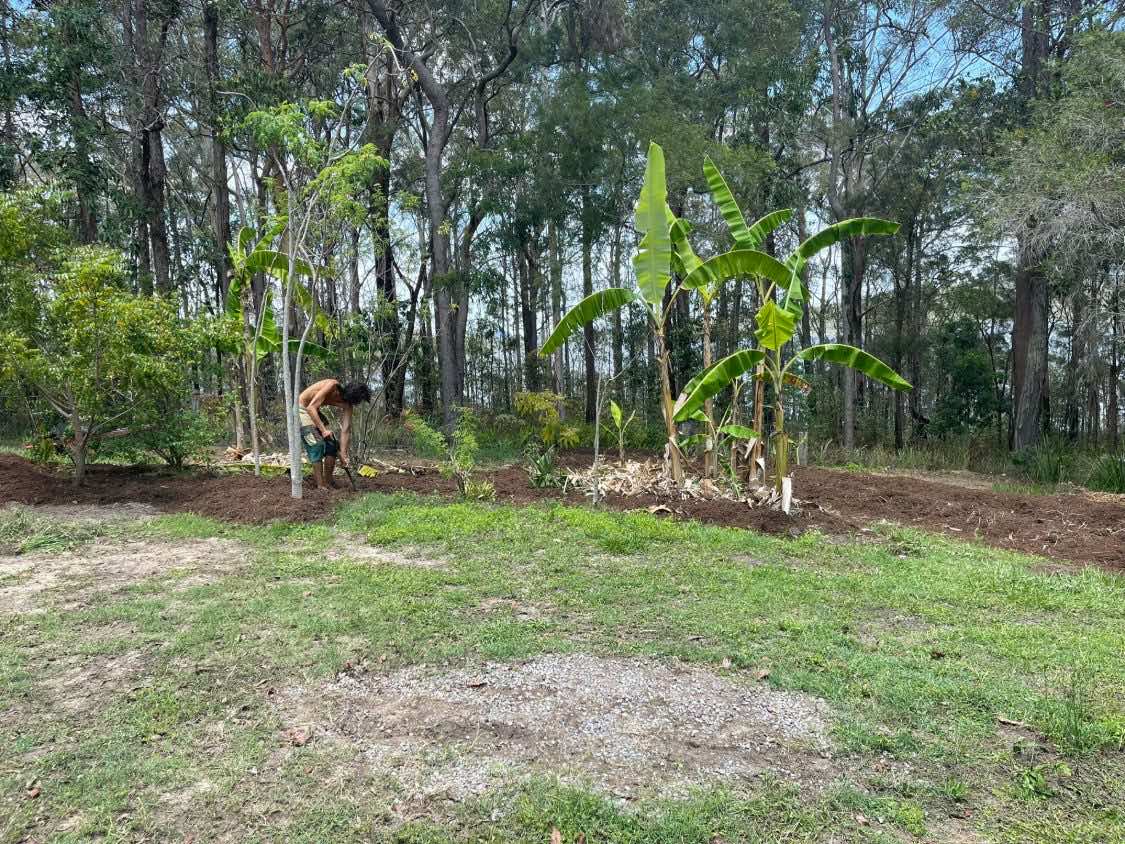
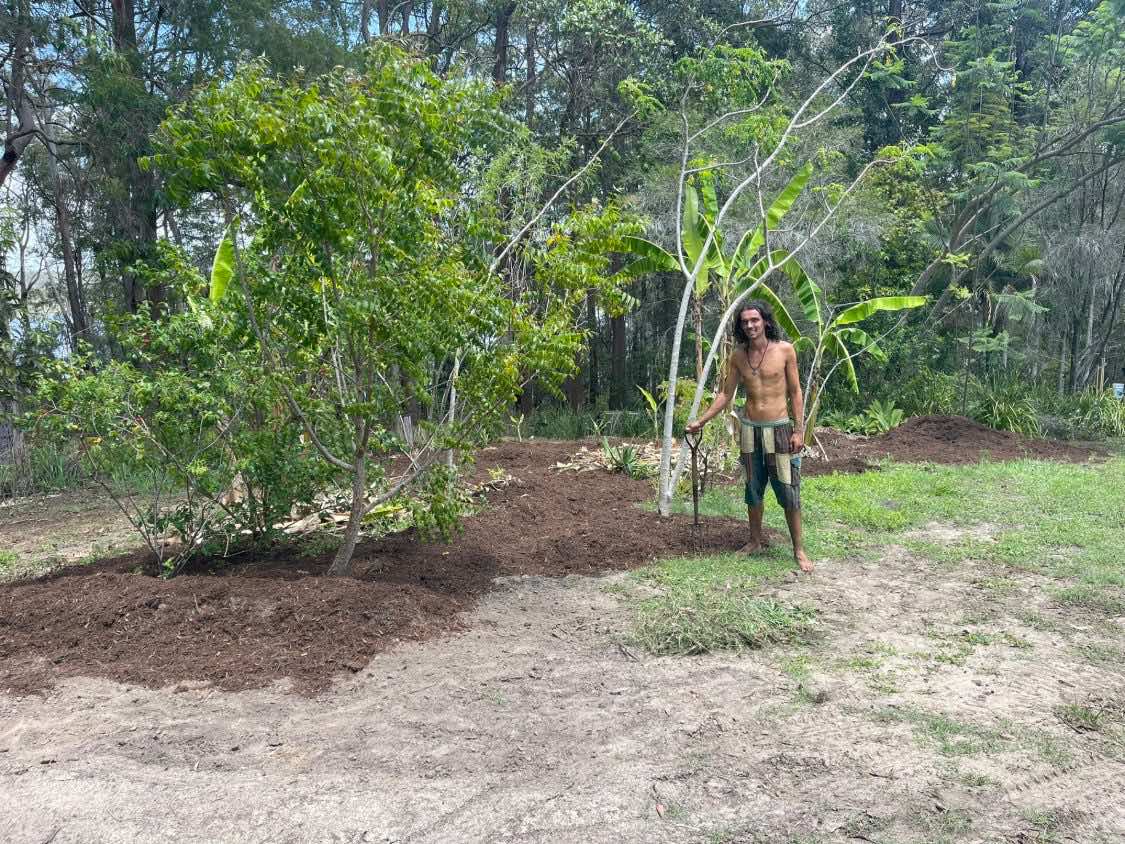
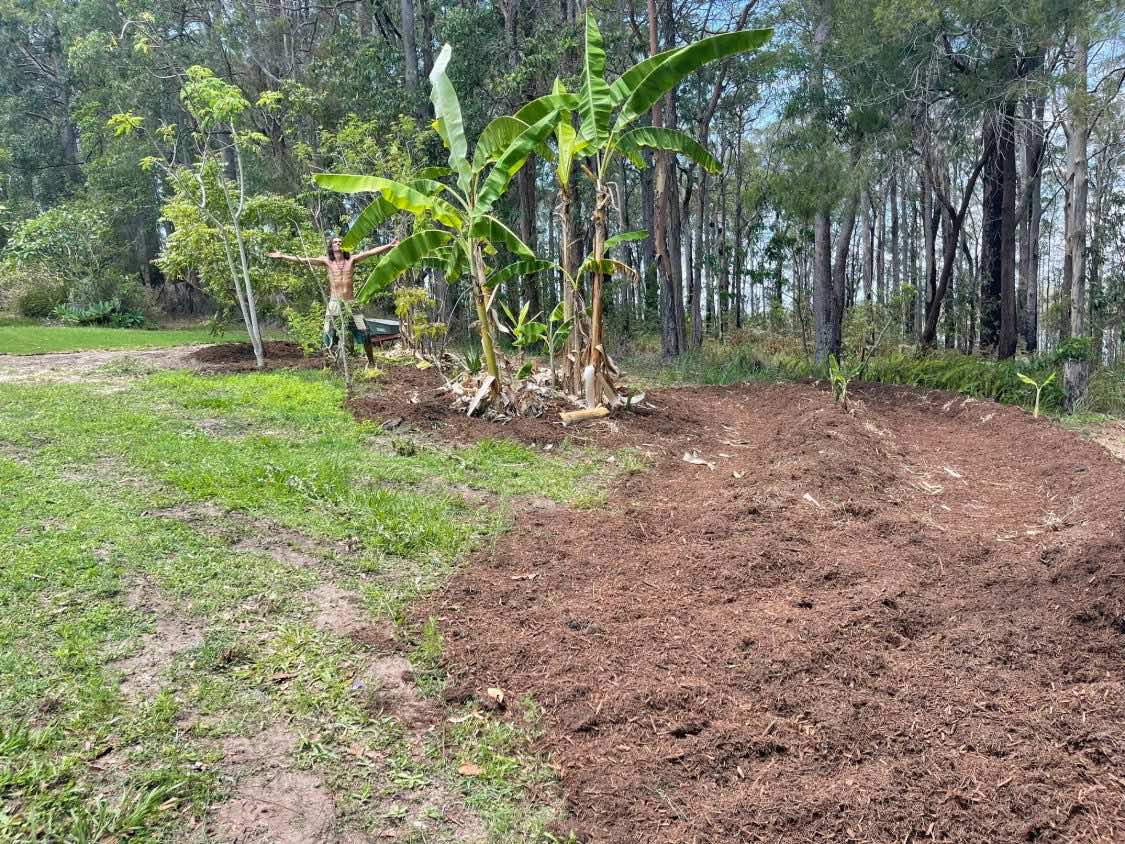
Sandy soil, mature gums competing for every drop of water, and three years of patient biomass. Glenview is the clearest demonstration on the route of what mulch and time actually do.
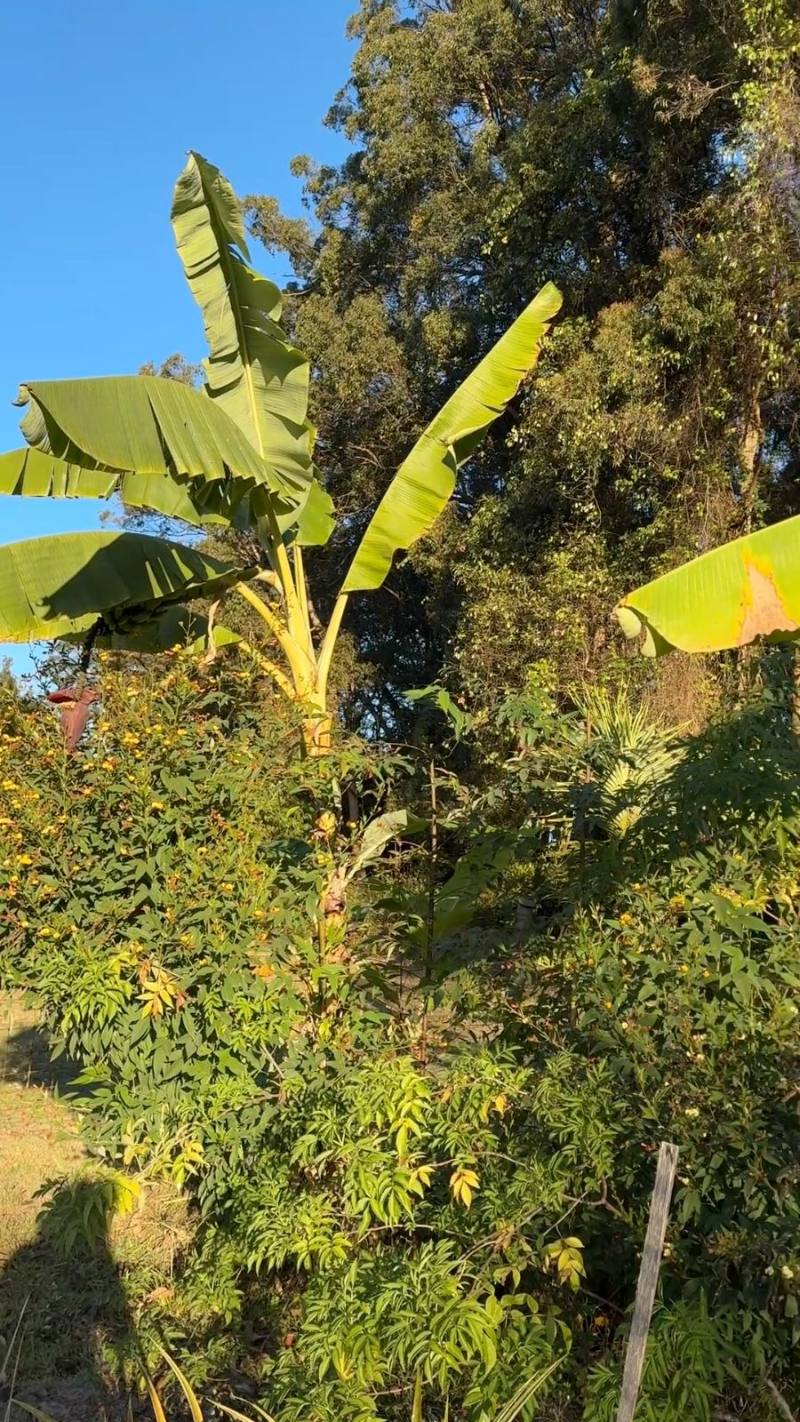
Three years of succession on the same ground: biochar made on site to hold nutrients in sandy soil, bananas now holding the canopy, the understory closed over, and enough biomass that the system is feeding its own fertility.
4 entries, newest first.
Working visit
A hard restorative prune
Glenview is stewarded by an elder who shares Qigong practice with me when I visit — the relationship is as much cultural exchange as it is garden work. Several years ago I helped expand the food forest around the established banana clump and diversify the plantings.
The orchard had become overgrown and needed substantial pruning to restore access, light and productive structure. The food forest at the top of the orchard is still affected by dry soil: it is sandy and free draining, and nearby mature gums (Eucalyptus spp.) compete hard for moisture. Soil cover and organic matter are not yet enough to hold water around the fruit trees through a dry stretch.
I completed a heavy restorative prune through the orchard, reopening the canopies to light and airflow. I put real effort into tidying the banana clumps (Musa spp.), pulling out old material and digging out excess suckers. The overgrown mugwort (Artemisia vulgaris) got a hard prune, and the avocado (Persea americana) was cut back to a more manageable structure.
There are gaps in the orchard where more fruit trees could go. Semi-mature grafted trees may be a practical way to diversify and bring new plantings into production sooner. The direction for the next stage is to strengthen the existing orchard and upper food forest first, before developing a new food forest on the lower slope.
What happens next
Bring in a load of mushroom compost to build organic matter in the upper food forest and orchard.
Apply a deeper layer of mulch around all fruit trees, kept clear of the trunks.
Walk and assess the lower slope before designing anything there — water movement, access, existing vegetation.
Return visit
Checking in on the way through
A deliberately light visit to assess the garden before carrying on to Banyula Zen, knowing I would be back soon.
The pigeon pea (Cajanus cajan) was flowering, and pinto peanut (Arachis pintoi) had settled in well in several areas — encouraging establishment for a living groundcover.
Two seed-grown fruit trees have come along remarkably. An avocado (Persea americana) I planted from seed is nearly twelve feet tall, and a jackfruit (Artocarpus heterophyllus) is around eight.
The mugwort (Artemisia vulgaris) had got away, and the bananas (Musa spp.) needed work across the garden — old material out, excess suckers removed. I lifted all the turmeric (Curcuma longa) out of one bed, shared a papaya (Carica papaya) with friends, and left the heavier work for the return.
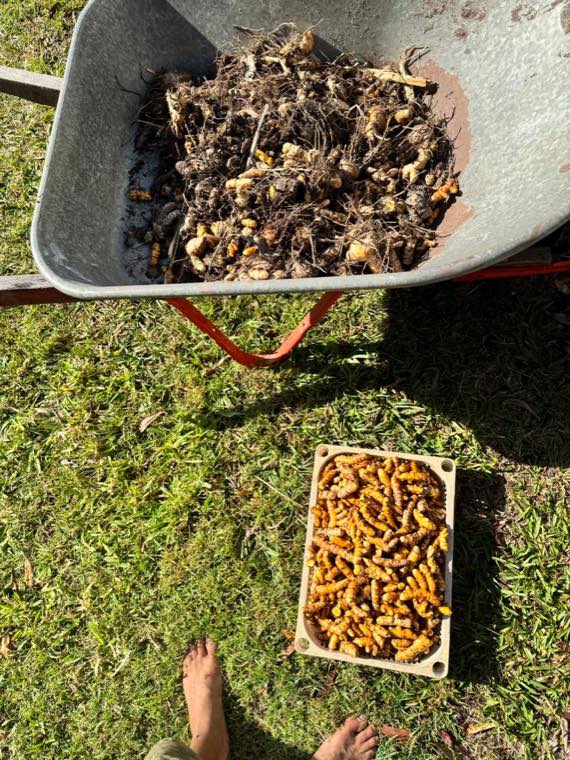
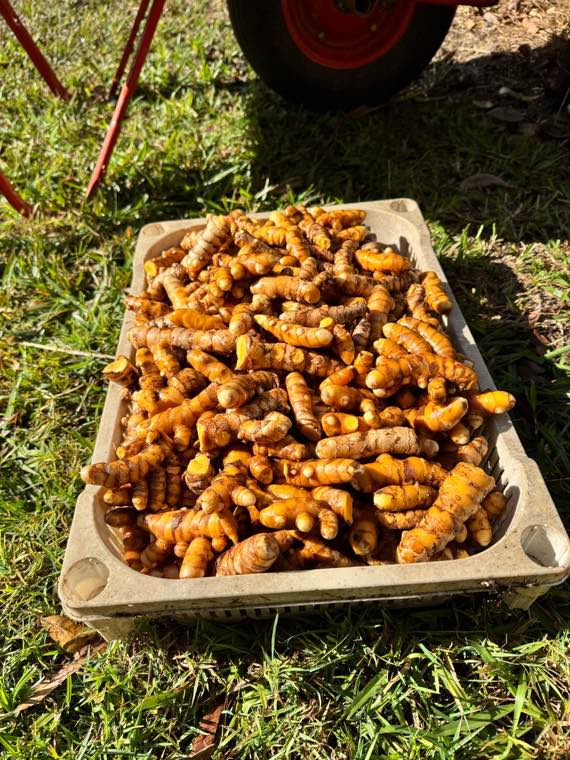
Lifting a turmeric bed is not the same as harvesting it. The whole barrow is mother stock, held back and replanted straight into the food forest, and only what is left over comes away as the crop. Done that way the bed renews itself and still feeds you, which is why one bed keeps giving rather than needing to be bought back in each season.
The turmeric bed, lifted
26 July 2026The barrow is all mother stock, going straight back into the food forest.26 July 2026What came away as crop, once the mother stock was set aside.
What happens next
Cut back and manage the overgrown mugwort.
Trash and desucker the banana clumps for access, airflow and structure.
Stewardship period
Mapping the high point, digging the top swale
A stewardship period that ran on from the first working week in December.
The banana clumps (Musa spp.) were showing lush growth after the earlier mulching — a clear sign the extra cover and organic matter were feeding the system.
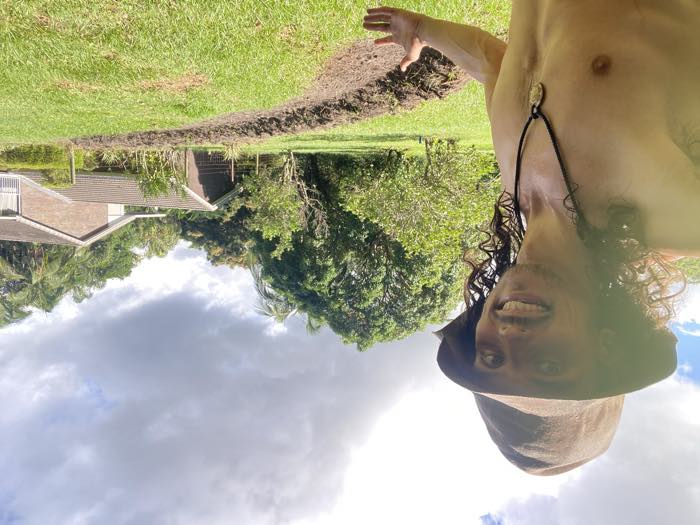
I used drone mapping to review the orchard layout and the shape of the property, which identified a position near the property's highest point for a new swale that could begin slowing and spreading water from high in the landscape.
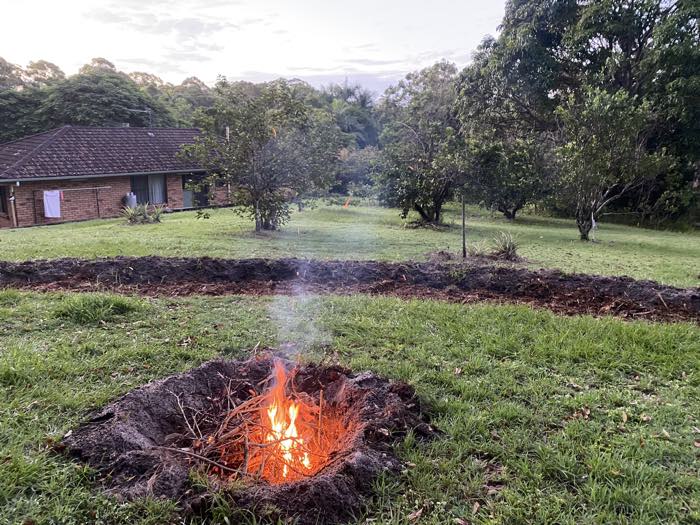
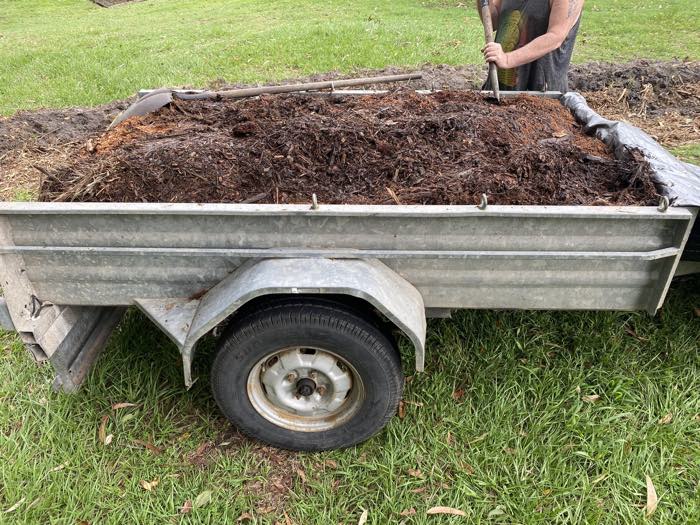
I spread more mulch through the food forest and productive areas, including some of the raised vegetable beds. More biochar was produced and then inoculated in a tub before going into the soil. The reason for making char here in particular is the ground itself: Glenview is sandy and free draining, so water and nutrients move straight through rather than staying where the roots are. Char is porous enough to hold both, and inoculating it first means it arrives already loaded instead of charging itself at the soil's expense. On sand there is little point importing fertility that will not stay put.
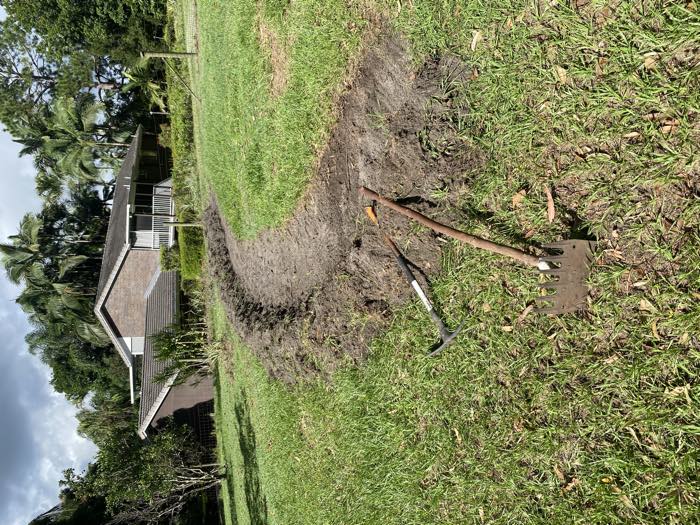
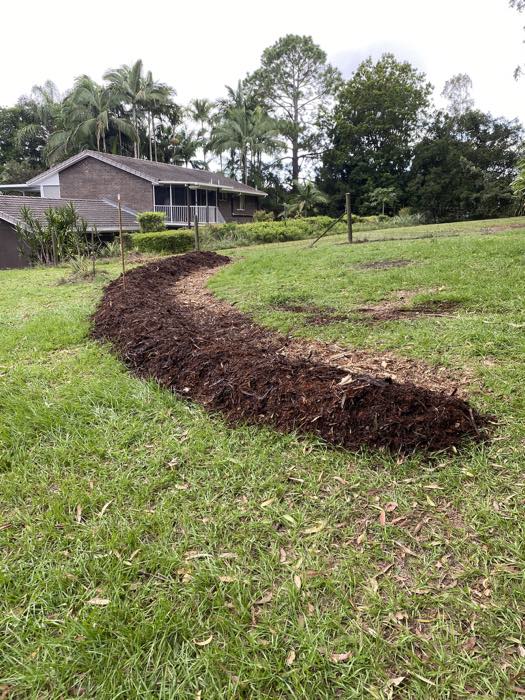
Then I dug the new swale at the top of the orchard, seeded the disturbed ground and covered it with mulch before leaving.
The top swale, 17 March 2024
17 Mar 2024 · 15:01Finished, before the seed and mulch went over the disturbed ground.
17 Mar 2024 · 15:00Cut on contour at the top of the orchard, mattock and fork down.17 Mar 2024Mulched over, and that is how I left it.
Char and mulch, the same day
17 Mar 2024Biochar burning down in a pit beside the new swale. On sand, char is what makes fertility stay.17 Mar 2024A trailer load of mulch, shovelled off by hand.
What happens next
Watch the new swale during rainfall and see how water spreads across the upper orchard.
Monitor the soil response where the inoculated biochar went in.
Installation
First swales behind the bananas
The first substantial week of work in this garden.
I spread a large volume of mulch through the working area to protect the soil, hold moisture and start building organic matter.
Two swales were dug behind the established banana clumps (Musa spp.), to slow water, encourage it to soak in, and support the banana-based food forest below them.
We also dug a pit for making biochar. Once it had served that purpose the pit was repurposed and developed into a garden bed, so the area kept an ongoing productive use.
Behind the bananas, first working period
Dec 2023Working the ground behind the established banana clump.Dec 2023One run mulched, fork down.Dec 2023Both swales in behind the bananas and mulched over.
What happens next
Watch how the two swales change infiltration and soil moisture around the bananas.